Two Years of "The Digital World":
Portable Courseware For Technological Literacy
Barry Fagin
Thayer School of Engineering
Dartmouth College
barry.fagin@dartmouth.edu
ABSTRACT
We report here our cumulative 2-year experience with the "The Digital World", a course designed to increase the technological literacy of non-science students. The course relies heavily on computer-aided instruction, including the extensive use of electronic lectures and multimedia. Students were able to acquire a surprising level of sophistication by working with examples of digital technology chosen from their daily lives. Students were also able to identify weaknesses in areas of current technology and public policy similar to those identified by experts.
We describe our successes and failures, and present cumulative data on performance, by major, class, and gender. All courseware and applications for "The Digital World" are available from the author.
1.0 INTRODUCTION
Three years ago, we began the development of a course entitled "The Digital World". Like existing courses elsewhere, this one would teach the basics of digital technology, but with two important differences: 1) it would be accessible to non-science majors, and 2) it would have no prerequisites. Our inquiries at Dartmouth and elsewhere indicated a growing consensus on the importance of technological literacy to a liberal arts education (see for example [NSF86], [NSF89], and [NSF90]). We felt existing efforts were inadequate.
We were also interested in reaching students who would not normally consider taking a science course; those in what Tobias calls the "second tier" [To90]. Tobias suggests that many bright students, particularly women, are alienated by traditional introductory science courses. Reaching these students is critically important in light of expected shortages in scientists and engineers over the next decade [Ma90]. We hoped that by presenting the right
material in an application-oriented, interactive fashion, we would be more successful at maintaining student interest. Finally, we were concerned about the monotonous pacing and dry presentation style of introductory science courses, often cited as a reason students leave a technical major [HeSe92].
Our first results were reported in [Fa93]. This paper updates data from [Fa93], and presents additional content and student project information.
2.0 STUDENT POPULATION
Our project began with an examination of student enrollment patterns at Dartmouth. Humanities course enrollment for the class of '89 is shown in Figure 1:
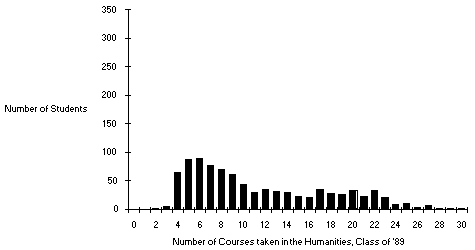
Figure 1: Humanities Course Enrollments [Hi91]
Figure 1 is a histogram showing the number of humanities courses taken by different members of a class. Although not completely flat, results are clustered fairly evenly from 4-10, and then slightly lower but still evenly from 11-22. There appears to be no statistically significant number of humanities courses that most students prefer.
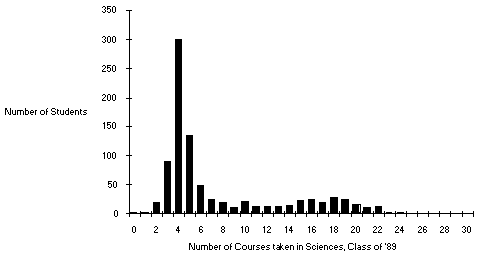
When science enrollments are examined, however, a different pattern emerges. Science course selection is shown in Figure 2. We see that the pattern is strongly asymmetrical, with a spike at the 4-course minimum required at Dartmouth. (Students with less than 4 science courses have received credit and/or special placement).
Figure 2: Science Course Enrollments [Hi91]
These results suggested to us that students who do not major in the sciences take only as many as they have to. A lack of science offerings suitable for students in the humanities also contributes to this problem. We developed "The Digital World" in response to the situation suggested by Figure 2.
A total of 43 students have taken "The Digital World". Breakdowns by gender, year, and major are shown below:
Table 1: Breakdown of Course Enrollment
GENDER CLASS MAJOR
Female: 8 Seniors: 14 Physical Sciences: 10
Male: 35 Juniors: 6 Social Sciences: 17
Sophomores: 8 Humanities: 6
Freshmen: 15 Undeclared: 10
The ratio of women to men in the course, while less than that of the College as a whole, is typical of science courses at Dartmouth. Surprisingly, the age distribution of the students was fairly even (we had expected mostly freshmen and sophomores).
The data on student majors shows that we still have not succeeded at attracting as many humanities majors as we had hoped. Students interested in the social sciences seem willing to make the leap to enroll in an engineering course, perhaps because the intellectual chasm they must cross is narrower for them than for humanities majors.
3.0 COURSE CONTENT IN 1993
"The Digital World" met three times a week, and contained a total of 28 lectures. The topics were divided as follows:
1) Fundamentals: 6 lectures. Discrete and continuous phenomena, binary notation, boolean algebra, logic gates, basic circuits.
2) Digitization of sound: 5 lectures. PCM, ECC's, how CD's work.
3) Digitization of images: 6 lectures. Bit mapped, grayscale, color images. Animation, image compression, HDTV.
4) Finite state machines: 3 lectures. Basic FSM structure, operation. Preparation for project.
5) Special topics: 6 lectures. Discrete information transmission in living systems (DNA), assistance with course project, modems, bar codes, the White House Clipper Chip encryption proposal and other topics taken from the popular press.
One lecture was reserved for an in-class midterm, and one lecture was held in an electronic music studio. Grades were based on homework assignments, a midterm, a final, and the project.
4.0 COURSE PROJECTS
In 1992, students were required to develop a state table for tic tac toe, which was used as input to software developed by the instructor. This software played the game against a human opponent using the table supplied as input. Strategies for both X and O were required. Based on student feedback indicating a desire for a more digital project, students who took the course in 1993 were required to design a circuit that played the game of NIM
*. Macintosh LogicWorks software was provided to simplify the task and to test student circuits. Both classes had their projects compete against each other and against the instructor in a tournament held on the last day of class.Projects were graded primarily for correctness, and secondarily for optimality and elegance. The instructor also completed the projects, and awarded special credit for students whose solutions were better than his own. Data on course projects is shown in Figures 3 and 4. For the tic tac toe project, size is reported as the number of lines in the state table. For NIM, it represents the number of gates. The instructor's solution is marked.
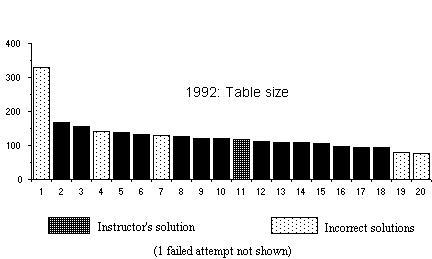
Figure 3: 1992 "Digital World" Project Data
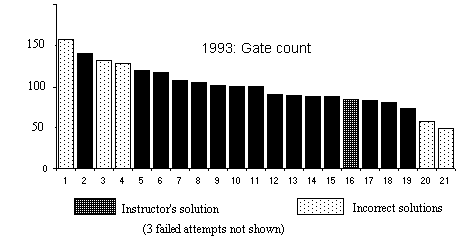
Figure 4: 1993 "Digital World" Project Data
67% of the students handed in completely correct projects. Another 23% handed in designs or tables that were partially correct, with the remaining 10% unable to complete the project. Considering the large number of social science and humanities majors in the course, and the large variation in intellectual ability and student interest, we regard student project performance as a success of "The Digital World". We were also pleasantly surprised at the number of students who were able to develop project solutions superior to those of the instructor.
5.0 COURSE MATERIAL DRAWN FROM CURRENT EVENTS
A certain number of lectures are set aside in "The Digital World" to respond to current events. Digital technology is a particularly fruitful area for policy discussions; newsworthy stories are virtually guaranteed to break while the course is being offered.
For example, approximately halfway through the term, the White House announced its proposed standard for data encryption, known as the "Clipper" proposal [NYT93].
The Clipper proposal is a voluntary data encryption standard that attempts to reconcile legitimate needs for encrypted communication with law enforcement agencies' desire to monitor criminal communications. It makes use of a secret encryption algorithm embedded in a chip, with decryption keys kept with two escrow agents. These agencies are expected to require a warrant before surrendering their keys to a law enforcement agency.
Once the basic mechanisms of the proposed standard were explained to students, they raised a number of concerns:
1) If the standard is voluntary, why expect criminals to employ it?
2) Who will decide who the trusted agents will be?
3) What guarantees will we have that warrants will be required?
4) How can the security of the chip manufacturing facility be guaranteed?
5) How do we know that the government cannot decrypt without the keys?
These and other objections were virtually identical to those voiced by Computer Professionals for Social Responsibility, the Electronic Frontier Foundation, and other professional organizations. Students reported this particular course topic to be among the most enjoyable.
6.0 USE OF COMPUTERS AND MULTIMEDIA
The material covered lent itself extremely well to computer-based presentation; it is safe to say that the concepts could not be effectively demonstrated without them. We present below some brief examples of how computers and multimedia were used. All material was developed and presented using a color Mac II with 4MB of RAM, running System 7.0 with the QuickTime extension.
1) Lectures and course administration. All lectures were developed and presented electronically as Hypercard stacks (version 2.1). Lectures were made publicly available on a file server before class for students to download and print. Students could also execute the lectures on their own machines, at their own pace and at times of their own choosing. Homeworks and other course-related materials were distributed electronically, and students were encouraged to use e-mail to communicate with the instructor in addition to scheduling office hour visits. Students reacted very positively to the extensively computerized format, regardless of background.
2) Application programs. Numerous application programs are required to present the material of "The Digital World". Programs used included the following:
Gates of Logic: Uses graphics to demonstrate principles of boolean logic. Developed by Prof. Jim Moor, Department of Philosophy, Dartmouth College. Available by request.
Logic Works: Simple circuit design and simulation Site licensed.
Image: Image processing program from NIH. Demonstrates effects of varying image quantization, filtering, and color maps. Public domain.
QuickGif: GIF image viewer. Public domain.
JPEG: Converts GIFs to JPEGs. Public domain.
JPEGView: JPEG viewer. Public domain.
Simple Player: Mac software for QuickTime animation. Bundled with System 7.0.
3) Sound and image processing. Much of "The Digital World" is concerned with the digitization of information, particularly sound and vision. The use of multimedia permits the class to hear the effects of varying sound quantization levels, to see how digital images can be altered, how light blends to give color, how motion can be digitized, and so forth. There is simply no way to demonstrate these concepts without a multimedia-based environment.
4) Project development and in-class tournament. Students completed the course project using LogicWorks for the Macintosh. Assignments were returned to the instructor electronically, and made to compete against each other on the last day of class. This was done interactively, with the students watching the progress of each game on the screen.
7.0 STUDENT PERFORMANCE
A breakdown of student performance by sex, class, and major is shown below:
Table 2: STUDENT PERFORMANCE (out of 100)
Men: 78 Seniors: 85 Physical science majors: 88
Women: 80 Juniors: 80 Social science majors: 82
Sophomores: 84 Humanities majors: 81
Freshmen: 70 Undeclared: 61
We see that on average women performed slightly better than men. This was first noted in [Fa93], and suggests that deliberate efforts by the author to remove aspects of classroom instruction known to alienate women may have had a positive effect [To90]. For example, the instructor used a random number generator to determine which students to call on, to ensure that opportunities to demonstrate competence were distributed fairly.
Our initial data showed little performance difference between grades, but now shows significantly weaker performance by freshmen. This may be an artifact of the course's popularity, in that the second offering of the course attracted considerably more freshmen than the first. Our data from 1992 also showed a significant difference in the performance of the science majors. While this difference is still present, it has since narrowed significantly. We regard this as an important success, demonstrating that students from outside the sciences can master basic concepts from digital technology.
8.0 CONCLUSIONS AND FUTURE WORK
In light of student feedback and our analysis of the course, we regard the following aspects of "The Digital World" as a success:
1) Addressing gender-based gaps in performance. Women outperformed men in "The Digital World", possibly due in part to deliberate efforts by the instructor. This included calling on students in a truly random fashion and employing a highly interactive teaching style. The content of the course may also have helped; it was made very clear in the catalog that this would not be a standard introductory science course.
2) Use of multimedia. Students responded very well to the use of computers, application programs, sound, image, and animation demonstrations. Students were already familiar with the Macintosh, and had little difficulty in exercising its multimedia capabilities.
3) Implementing a non-trivial programming project. Almost all students completed the course project, and most of those that completed it received a perfect score. Students found their newly discovered programming and digital circuit design abilities very gratifying.
4) Choice of material. Students responded very well to the material on CD's, the Macintosh, and HDTV. The fortuitous announcement of the Clipper encryption chip proposal from the White House during the middle of the course provided extremely fertile ground for discussion. Even the humanities majors asked very sophisticated questions in these areas, questions that went beyond the planned presentation of the instructor. The importance of introducing theoretical material with accompanying applications familiar to the student cannot be overemphasized.
We regard the following aspects as needing further improvement:
1) Producing a paperless course. Although the vast majority of material in "The Digital World" was electronic, students printed out complete lectures and brought them to class. This often produced more paper than if the lectures had not been electronically available in the first place. It also created a strain on public printing resources.
2) Incompatibilities between students and instructor platforms. Due to differences between student and instructor computing platforms, students had occasional problems in viewing lectures and executing programs on their own machines. This led to frustrating experiences in which students blamed themselves for their machine's inability to execute a piece of software.
3) Attracting a larger number of humanities majors to the course. Although some humanities majors have taken the course, we would like to see them become at least half of enrollment. We hope to achieve this by improving the way the course is marketed. We are also considering limiting the number of science majors who enroll.
We have several plans for future versions of the course. We hope to incorporate still more multimedia-based material into the lectures, and to write our own custom application programs better suited to the concepts we wish to illustrate. We will concentrate very carefully on students from outside the sciences, emphasizing repeatedly that they can master all the material covered in class if they abandon any preconceptions they have and apply critical thinking skills.
Our most ambitious plans call for replacing the software project with a chip. Students will create finite state tables, as before, but these tables will be used to program a field programmable gate array that lights LED's appropriately in response to input moves. Students will thus be able to design their own chips that play tic-tac-toe or some other game.
All course materials produced for "The Digital World" are available for public distribution. We anticipate further refinements and greater availability as we continue to offer and improve the course.
9.0 ACKNOWLEDGEMENTS
Funding for this project was made possible by a grant from the New England Consortium for Undergraduate Science Education, and by the National Science Foundation's Undergraduate Course and Curriculum Development Program through grant #USE-9156226. The author is also grateful for the use of equipment supplied by Apple Computer Corporation.
10.0 REFERENCES
[Fa93] Fagin B., "The Digital World: Teaching Technological Literacy to a Multidisciplinary Audience", Proceedings of the 1993 National Educational Computing Conference, June 1993, pp 116-121.
[HeSe92] Hewitt, N. and Seymour, E., "A Long, Discouraging Climb", ASEE PRISM, February 1992, pp 24-28.
[Hi91] Hitchcock, Charles et. al., Report of the Task Force on Curriculum Development for Technological Literacy, Thayer School of Engineering, Dartmouth College, March 1991.
[Ma90] Malcolm, S., "Who Will Do Science in the Next Century?", Scientific American, February 1990, p 112.
[NSF86] Undergraduate Science, Mathematics, and Engineering Education/ National Science Foundation, National Science Board Task Committee on Undergraduate Science and Engineering Education, H. A. Neal, Chair -- [Washington, DC]: National Science Foundation, 1986-1987. NSF Pub. No. NSF 86-100.
[NSF89] Report on the National Science Foundation Disciplinary Workshops on Undergraduate Education: Recommendations of the disciplinary task forces concerning issues in U.S. undergraduate education in the Sciences, Mathematics and Engineering/Division of Undergraduate Science, Engineering, and Mathematics Education, Directorate of Science and Engineering Education -- [Washington, DC]: National Science Foundation, 1989. NSF Pub. No. NSF 89-3.
[NSF90] Report of the National Science Foundation Workshop on the Dissemination and Transfer of Innovation in Science, Mathematics, and Engineering Education: Division of Undergraduate Science, Engineering, and Mathematics Education, Directorate for Education and Human Resources, National Science Foundation, May 1990. NSF Pub. No. NSF 91-21.
[NYT93] Markoff, J., "New Communication System Stirs Talk of Privacy vs. Eavesdropping", New York Times, April 16th 1993.
[To90] Tobias, S. "They're Not Dumb, They're Different: Stalking the Second Tier", Research Corporation, 1990.
[WiCe90] Wineke, W.R. and Certain, P., The Freshman Year in Science and Engineering: Old Problems, New Perspectives for Research Universities. A report of a conference sponsored by The Alliance for Undergraduate Education with support from the National Science Foundation. [University Park, PA]: The Alliance for Undergraduate Education, 1990.